Your Association Needs an Operating Calendar, Not Just an Event Calendar
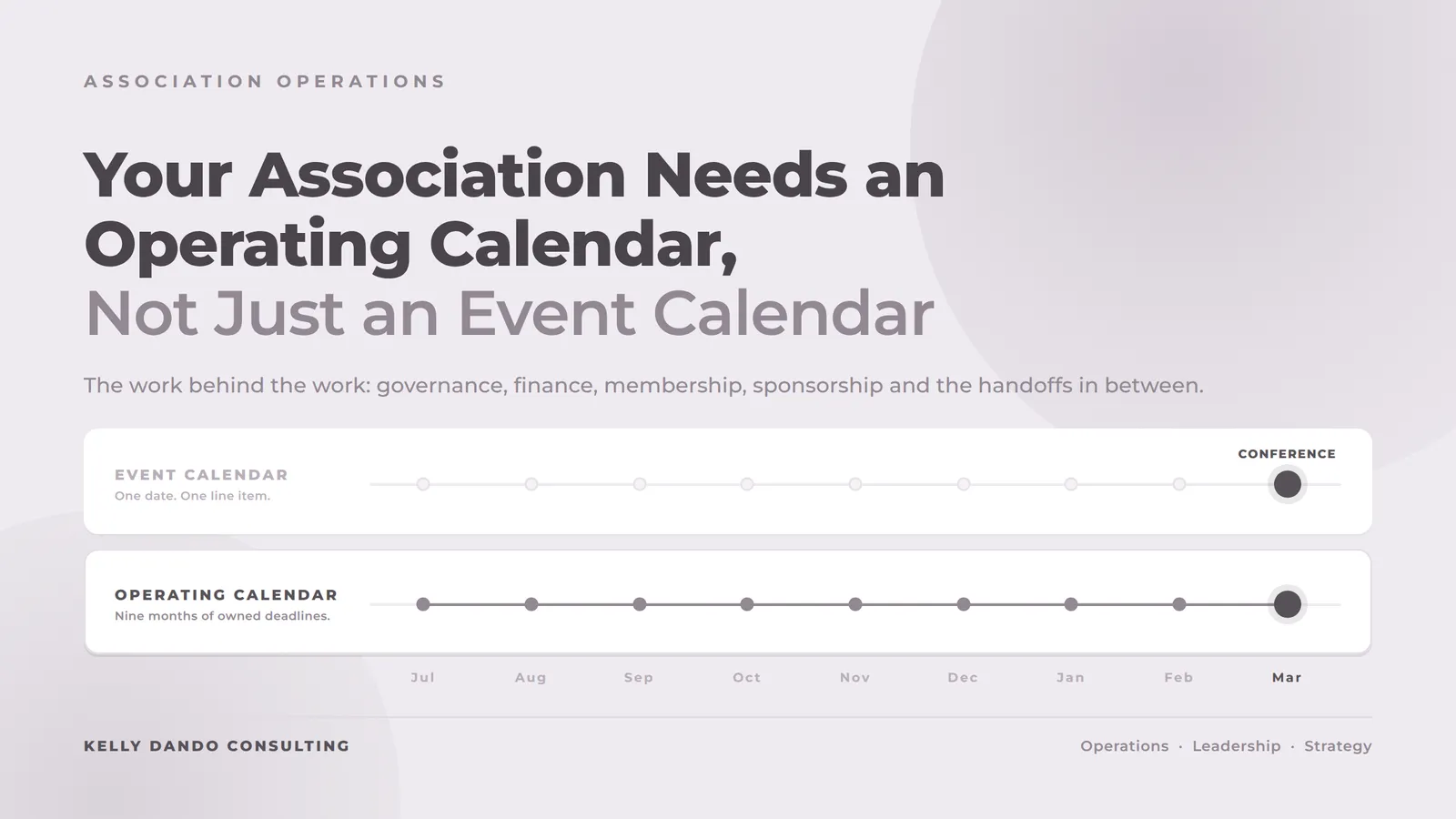
Most associations have a calendar.
Board meeting.
Luncheon.
Golf tournament.
Annual conference.
Holiday party.
That’s an event calendar.
It is not an association operating calendar.
An operating calendar answers a completely different question:
What has to happen behind the scenes, and when, for all of those things to work?
That’s the calendar I wish every volunteer-led association had.
Because when you don’t have one, the organization runs on memory.
And memory works beautifully right up until the person remembering everything rotates off the board.
What is an association operating calendar?
An association operating calendar is a twelve-month map of the work behind the work.
An event calendar tells you what is happening. An operating calendar tells you what has to happen first, who owns it and when it starts.
It covers seven cycles: governance, finance, membership, events, sponsorship, communications and leadership transitions.
Done well, it becomes the association’s memory instead of the president’s.
Your calendar should know more than your president does
I recently wrote about the difference between a process and a habit.
If something happens because “Susan always remembers to do it,” that’s a habit.
If it’s documented, assigned and repeatable regardless of who is serving this year, that’s a process.
An annual operating calendar is one of the simplest ways to turn organizational habits into organizational processes.
It becomes the place where the association remembers things so individual people don’t have to.
Start with the board governance calendar
Put every required board and governance milestone on the calendar first.
Not just meeting dates.
Include when agendas must be prepared.
When board materials go out.
When committee reports are due.
When nominations begin.
When elections happen.
When new officers are confirmed.
When the board orientation takes place.
When goals are reviewed.
When bylaws or policies are scheduled for periodic review.
If the president has to remember all of those deadlines personally, you don’t have governance infrastructure.
You have a very organized president.
Those aren’t the same thing.
Add the financial cycle
Next, add your financial rhythm.
When does the board approve the annual budget?
When are financial statements reviewed?
When should major event budgets be approved?
When do sponsorship invoices go out?
When does membership billing begin?
When are renewals considered past due?
When does your accountant need year-end information?
When are annual filings due?
When should insurance policies be reviewed or renewed?
Now your calendar is starting to look less like an event schedule and more like an operating system.
That’s the goal.
Map the membership year
Most associations put the renewal deadline on the calendar.
That’s too late.
Map the whole member journey.
When do renewal notices start?
When does personal outreach begin?
When do you review lapsed members?
When do you run recruitment campaigns?
When are new members welcomed?
When do you invite members into committees?
When do you evaluate engagement?
When do you survey members?
When do you review dues or member benefits for the following year?
Membership isn’t something that happens during renewal season.
It’s a twelve-month relationship.
Your calendar should reflect that.
Work backward from every major event
Put the event date on the calendar.
Then keep going backward.
For a large conference, that might mean:
- venue decisions
- budget approval
- speaker recruitment
- sponsor prospectus development
- sponsor outreach
- registration launch
- early-bird deadlines
- marketing campaigns
- final guarantees
- AV deadlines
- printing
- name badges
- attendee communications
- onsite assignments
- post-event surveys
- sponsor follow-up
- financial reconciliation
Suddenly the “March conference” isn’t something that happens in March.
It’s something the association has been managing since the previous summer.
That’s why events become overwhelming for volunteer boards. The event itself lasts a day or two. The work surrounding it lasts months.
Give sponsorship its own calendar
Sponsorship should not begin when someone remembers to update last year’s prospectus.
Build a cycle.
When will you evaluate last year’s packages?
When will you talk with returning sponsors?
When does the new prospectus need to be ready?
When does outreach start?
When do invoices go out?
When are logos and other materials due?
When do sponsor benefits need to be fulfilled?
When will the association follow up after the event?
Sponsorships become much easier to renew when fulfillment and relationship management aren’t being reconstructed from scratch every year.
Add communications last
Once the operational milestones are in place, communications become much easier to plan.
You already know when registration opens.
Now you know when the save-the-date needs to go out.
You know when membership renewals begin.
Now you can build the email sequence.
You know when board nominations open.
Now you can schedule the announcement.
Instead of asking every month, “What should we post?” your communications calendar starts serving the organization’s actual priorities.
Marketing works better when it follows operations instead of trying to invent activity around them.
Don’t forget the handoffs
This may be the most important part of the calendar.
Volunteer associations change leadership constantly.
Add transition dates intentionally.
When should incoming officers receive access?
When are files transferred?
When should committee chairs meet with their successors?
When are passwords and account permissions reviewed?
When does the new board receive orientation?
When are annual goals carried forward?
Your association should not have to restart every time a new president takes office.
Leadership can change.
The operating system shouldn’t.
Put an owner beside every deadline
A calendar full of dates is still just a calendar.
Every meaningful milestone should have an owner.
Not “Membership Committee.”
A person.
Not “Board.”
A person.
Not “KDC.”
A person.
Someone should know that they are responsible for making sure the next step happens.
And when leadership changes, the owner’s name changes.
The task doesn’t disappear.
Review it quarterly
Your association management calendar is not meant to be perfect.
It’s meant to get better.
Once a quarter, spend ten minutes asking:
What surprised us?
What deadline did we miss?
What did someone have to remember manually?
What started too late?
What should we add before next year?
That’s how institutional knowledge gets built.
Not in someone’s head.
In the system.
The real goal is continuity
A good annual operating calendar won’t make your association exciting.
Nobody is going to post a picture of it on LinkedIn.
But it does something much more important.
It makes the organization less dependent on any one person.
The president can rotate off.
The treasurer can take a vacation.
A committee chair can step down.
And the association still knows what happens next.
That’s what good association management looks like behind the scenes.
The work feels seamless because somebody, or some system, is always looking three months ahead.
Common questions about association operating calendars
How is an operating calendar different from an event calendar?
An event calendar lists what the association is doing. An operating calendar lists the preparation, deadlines, approvals and handoffs that make those things possible. The event calendar is the visible layer. The operating calendar is the infrastructure underneath it.
When should we build ours?
Build it during your slowest quarter, not during conference season. Start with one full year of governance and financial deadlines, then layer in membership, events and sponsorship. A partial calendar in use beats a perfect one still in draft.
Who should own the association operating calendar?
Somebody whose role does not turn over every year. In a volunteer-led association that usually means staff or an association management company. If the calendar lives with an officer who rotates off, you have rebuilt the exact problem the calendar was meant to solve.
How far out should it go?
Twelve months minimum, rolling. Large conferences and board transitions often need eighteen. If your annual meeting drives your fiscal year and your nomination cycle, those three should be mapped together.
Does your association feel like it’s reinventing the wheel every year? Kelly Dando Consulting helps volunteer-led associations document processes, build governance calendars, manage board and committee transitions and keep operations moving regardless of who is serving this year.
Let’s talk about what your association’s operating calendar should look like.