The Association Treasurer Checklist: Building a Financial Rhythm Your Board Can Count On
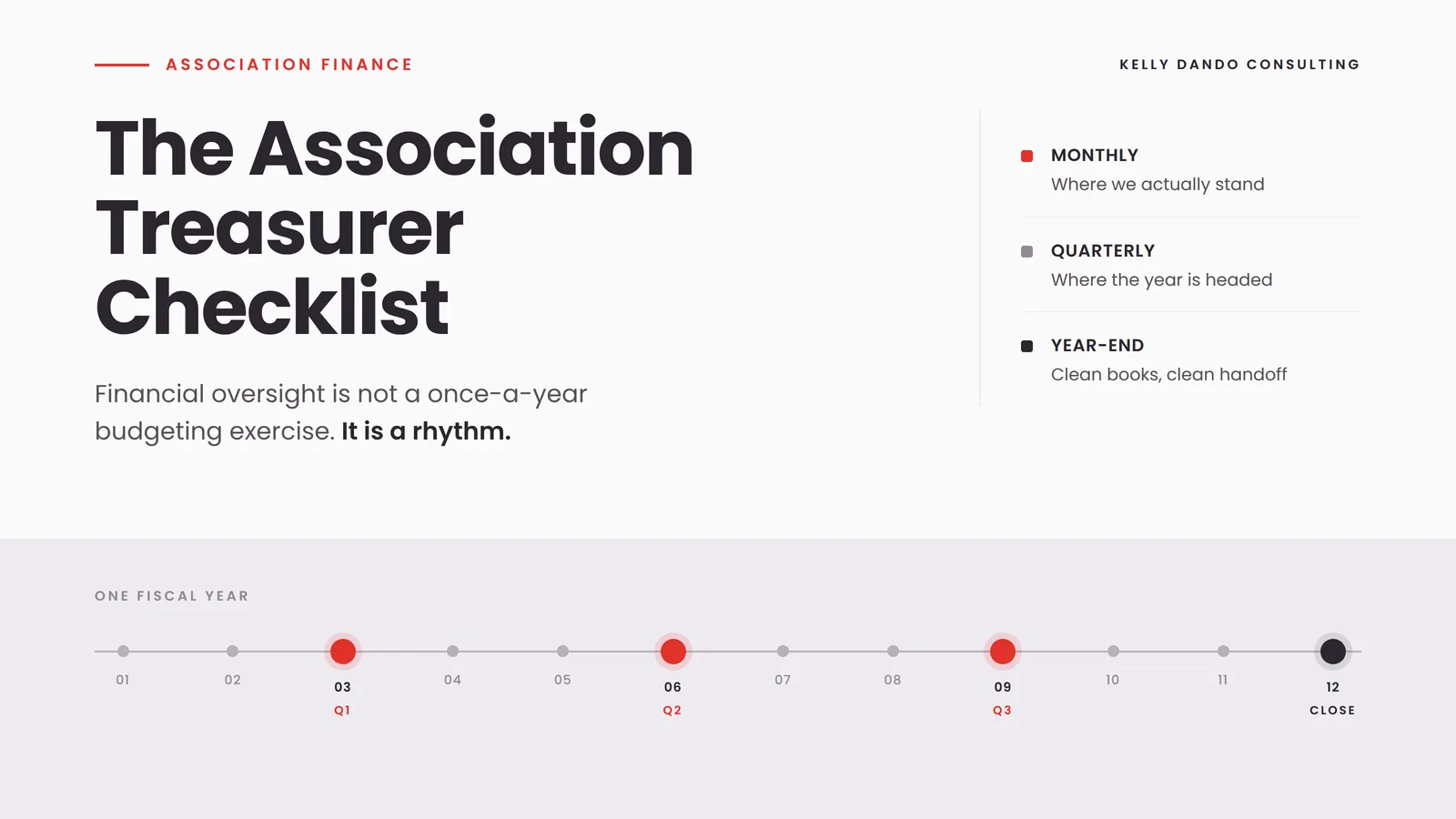
The association treasurer gets treated like the person who gives a five-minute financial report at the board meeting.
Anyone who has actually held the job knows better.
Depending on the size of the organization, the treasurer is reviewing statements, approving bills, watching cash, fielding budget questions, working with the accountant, chasing receivables, prepping for tax filings, and explaining to the rest of the board why “we have money in the bank” and “we are on budget” are not the same sentence.
In a volunteer-led association, they’re doing all of that around a full-time job.
That’s a lot to hand one person.
The fix isn’t a better treasurer. It’s a better rhythm. Financial oversight falls apart when it’s treated as a once-a-year budgeting exercise and everything in between is vibes.
Start with your fiscal year, not January
Plenty of associations don’t run on a calendar year, so ignore the month on the wall. Start at Month One of your fiscal year and build the same checkpoints into your board calendar every single year.
The goal is straightforward.
There should never be a month where your board has no idea how the organization is performing.
That doesn’t mean the board debates every transaction. It means the right people are looking at the right information on a schedule.
Every month: know where you actually stand
At minimum, the treasurer should be getting statements often enough to answer these without going digging:
- How much cash do we have?
- How do actual revenues and expenses compare to budget?
- What’s sitting unpaid that we should be collecting?
- What bills need attention?
- Is event, membership or sponsorship revenue meaningfully ahead of or behind where we expected?
- Is there anything unusual that needs an explanation?
A monthly P&L by itself doesn’t tell you much. Variance is the part that matters.
If you budgeted $40,000 in sponsorship and you’re at $12,000 halfway through the year, that’s a conversation.
If an event is over budget because attendance came in 30 percent above forecast, that’s a completely different conversation and possibly good news.
Numbers without context just make boards nervous.
Every quarter: zoom out
Monthly reporting tells you what happened. Quarterly reporting should help the board decide what happens next.
Once a quarter, pull up:
- Are we still likely to finish the year near budget?
- Are dues renewals tracking where they should be?
- Are event revenues actually covering event costs?
- Is sponsorship coming in on schedule?
- Which expense categories keep running over?
- Do upcoming commitments change our cash position?
This is where reporting turns into management instead of bookkeeping.
No board should find out in November that it’s been running behind since March.
Don’t let receivables go invisible
This is the easiest money in the world for a volunteer-led organization to lose track of.
Someone registers for an event and asks to be invoiced. A sponsor commits. A member renews but never finishes the transaction.
Then everyone gets busy. Thirty days becomes sixty. Sixty becomes ninety.
The revenue still shows up on somebody’s spreadsheet. It just isn’t in the bank.
Build a repeatable process. Who follows up. When they follow up. When an unpaid balance gets escalated and to whom. And make sure someone is regularly comparing what was promised against what was actually collected, because those two lists drift apart faster than anyone expects.
Stop saving the budget for budget season
A lot of boards look at the budget exactly twice. Once when they approve it, once when the year closes.
That’s not a management tool. That’s a historical document.
Your budget should be helping the board make calls all year.
Event attendance beating projections? Maybe there’s room to invest in programming. Membership revenue lagging? Maybe that discretionary expense waits a quarter. Sponsorship way ahead of goal? Then the board gets to decide on purpose what to do with the surplus, instead of stumbling into it in month twelve.
Steer with it. Don’t file it.
Put reserves into the conversation
Healthy reserves create stability. But piling up cash isn’t a strategy, and “we should probably have more” isn’t a policy.
Your board should be able to say why the reserves exist and what level is right for your organization.
Are they there for a cancelled conference? An unexpected legal or professional bill? A soft membership year? A technology replacement you know is coming? A strategic investment you want to be ready for?
Whatever the answer, write it down.
Reserve decisions get dramatically easier when this year’s board understands what a previous board intended.
Give events their own financial conversation
For most associations, events are the biggest chunk of both revenue and expense. Don’t bury them inside the annual statement where nobody can see them.
Look at your major events one at a time:
- What did we budget?
- What came in from registration?
- What did sponsorship generate?
- What did the venue cost?
- Food and beverage?
- AV?
- What was the actual net?
Then the question that makes all of it useful: how does that compare to last year?
That’s the information that makes next year’s event budget something better than a guess.
Prepare for year-end before year-end
The close of the fiscal year should not kick off a scavenger hunt.
Well ahead of it, confirm that records are organized, vendor information is complete, receivables are being worked, reconciliations are current, and whoever handles your filings and reports has what they need.
Your accountant or tax professional should be the one guiding your association on its specific filing requirements. The board’s job is narrower: make sure the process has an owner and a deadline.
“Someone is handling it” is not a financial control.
A name and a date are.
The most overlooked task: the treasurer handoff
Every time a treasurer rotates off, the association is one transition away from losing everything that person knew.
Before the handoff, get it written down:
- Where the financial reports live
- Who has access to bank and accounting systems
- What recurring payments exist
- Who approves expenditures
- Who the accountant and other financial contacts are
- When major filings happen
- How invoices and reimbursements get processed
- What issues the incoming treasurer should be watching
The goal isn’t for the new treasurer to learn everything the old treasurer knew.
The goal is for the organization to know it, so the next transition is a calendar item instead of an emergency.
What good financial management actually buys you
Your board members don’t need to become accountants. They need enough visibility to make decisions without guessing.
The associations that handle this well all have the same thing in common. Monthly visibility. Quarterly forecasting. A budget they actually use. Documented processes. Clean transitions.
That structure protects the money, sure.
But it also gives volunteer leaders something they rarely say out loud that they want: the confidence that nothing important is quietly slipping past them.
Need more structure around association operations and financial coordination? Kelly Dando Consulting supports volunteer-led associations with budgeting, invoicing and receivables coordination, financial reporting, board administration, and the systems that keep work moving between meetings.