Relationships Are the Product. Everything Else Is Delivery.
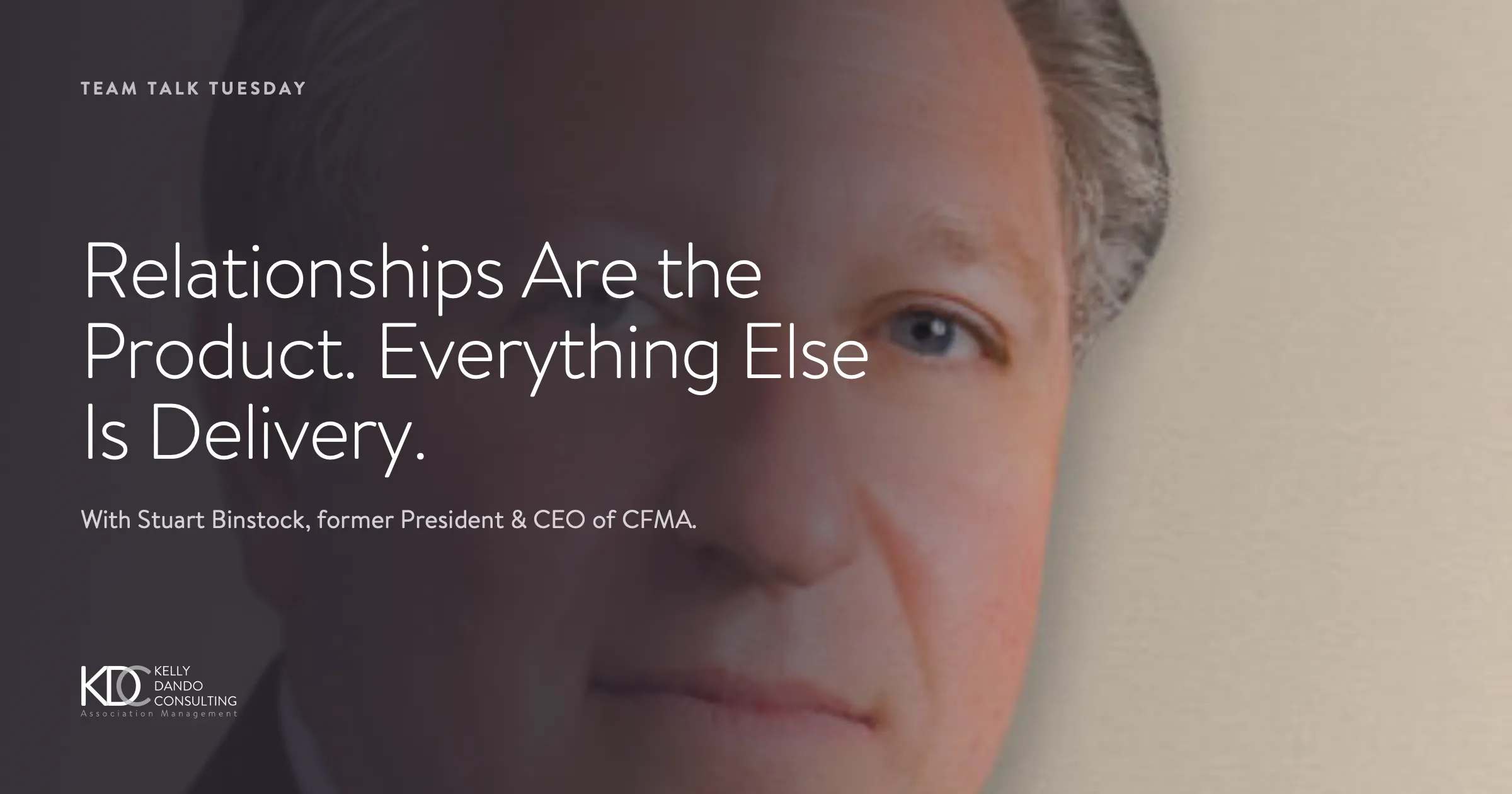
What Stuart Binstock taught us about the one thing associations have never had to reinvent.
We spend a lot of time in this industry talking about what has changed. New platforms. New generations. New expectations about how fast we respond and how short we write. It is a fair conversation to have, and we have it constantly.
But when Jamie and I sat down with Stuart Binstock for Team Talk Tuesday, we asked him the other half of that question. What hasn’t changed?
His answer took about four seconds.
It has always been about relationships. It is today. It always was.
Stuart spent more than a decade as President and CEO of CFMA, and before that he worked at AGC, AIA and NECA. He has been in this world long enough to have watched associations operate without email, without websites, without a single social channel. He is also retired now, which means he says what he actually thinks. That combination made for a good hour.
The delivery changed. The product didn’t.
Ask Stuart what shifted most over his career and he goes straight to adaptability. When he started at AGC, you sent a mailing and members learned what was happening. That was the whole distribution strategy. Now you are expected to be on LinkedIn, on Facebook, in the inbox, in the app, and everywhere else your members happen to be looking.
That is real, and it is exhausting, and it is also not the point.
All of that is delivery. The thing being delivered has not moved in fifty years. Members join to be connected to people who understand their work. Everything we build around that is packaging.
This matters practically. When you are deciding where to spend a chapter’s limited hours, the test is not whether an activity is modern. The test is whether it creates a relationship that would not otherwise exist. A slick newsletter that nobody replies to loses that test. A badly organized coffee meetup where two members find each other wins it.
Why in-person is worth more now, not less
Here is the moment in the conversation that stopped me.
Stuart was talking about job hunting. He described how he used to write a fresh letter for every single position he applied to, tailored to that specific role, because he believed showing focus mattered. Then he said he is not sure that would even work today. Large employers run keyword filters. Software reads the resume before a person ever does.
Sit with that for a second, because it is the strongest argument for association membership anyone has made to me in a while.
When an algorithm is the first gate, personal access becomes scarce. Scarce things get more valuable. The member who met a CFO at a chapter meeting is not competing in the same pile as the four hundred applications that got filtered on keywords. They skipped the gate entirely.
We tend to pitch networking as a soft benefit. A nice-to-have. Something you mention third on the membership page. That framing is outdated. In a market where the first reader is a machine, a room full of humans who know your name is a hard, measurable advantage. We should be selling it that way.
Learn the industry, not just the job
This was the most uncomfortable part of the conversation, and probably the most useful.
Stuart said the thing that made him effective at CFMA was that he could talk to members about their actual business. He could discuss design-build versus design-bid-build. He knew the industry’s mechanics. Most people in association management, he said, learn membership and recruiting. They do not learn the industry itself.
He is not wrong, and I say that as someone who runs an association management company.
His suggested fix is refreshingly cheap. Ask a member to walk you through a job site. Call someone and ask what they wish they had known earlier. He compared it to an informational interview, the thing career advisors used to push and almost nobody does anymore. You do not need a certification. You need curiosity and a willingness to ask.
Members can tell the difference between an administrator and someone who understands their world. One gets compliance. The other gets trust.
Build the pipeline on purpose
We asked Stuart about volunteers, because every chapter we work with struggles here. His answer was one word first: intentional.
At the national level, CFMA ran a mentoring program that selected eight to ten people a year who showed leadership potential and paired them with a past leader. It worked on two levels. Participants got professional development, which is honestly why most of them signed up. They also got a guide who could show them what involvement actually looks like and why it is worth their time.
That is the part chapters miss. Hoping people raise their hands is not a program. Waiting until elections and then filling seats with whoever did not leave the room is not a program either. A mentoring pairing is small enough for a chapter to run and specific enough that people say yes to it.
One more thing
There is a story in this episode about an article that was nowhere in CFMA’s strategic plan. Someone brought it to Stuart, he decided to print it and see what happened, and the response reshaped how an entire industry talks about mental health. It became the Construction Industry Alliance for Suicide Prevention.
He calls that his proudest accomplishment. It also came from breaking the plan.
Worth remembering next time your board treats the strategic plan like scripture. It is a guide. Some of the best things you will ever do will not be on it.
Listen to the full conversation with Stuart Binstock on Team Talk Tuesday.